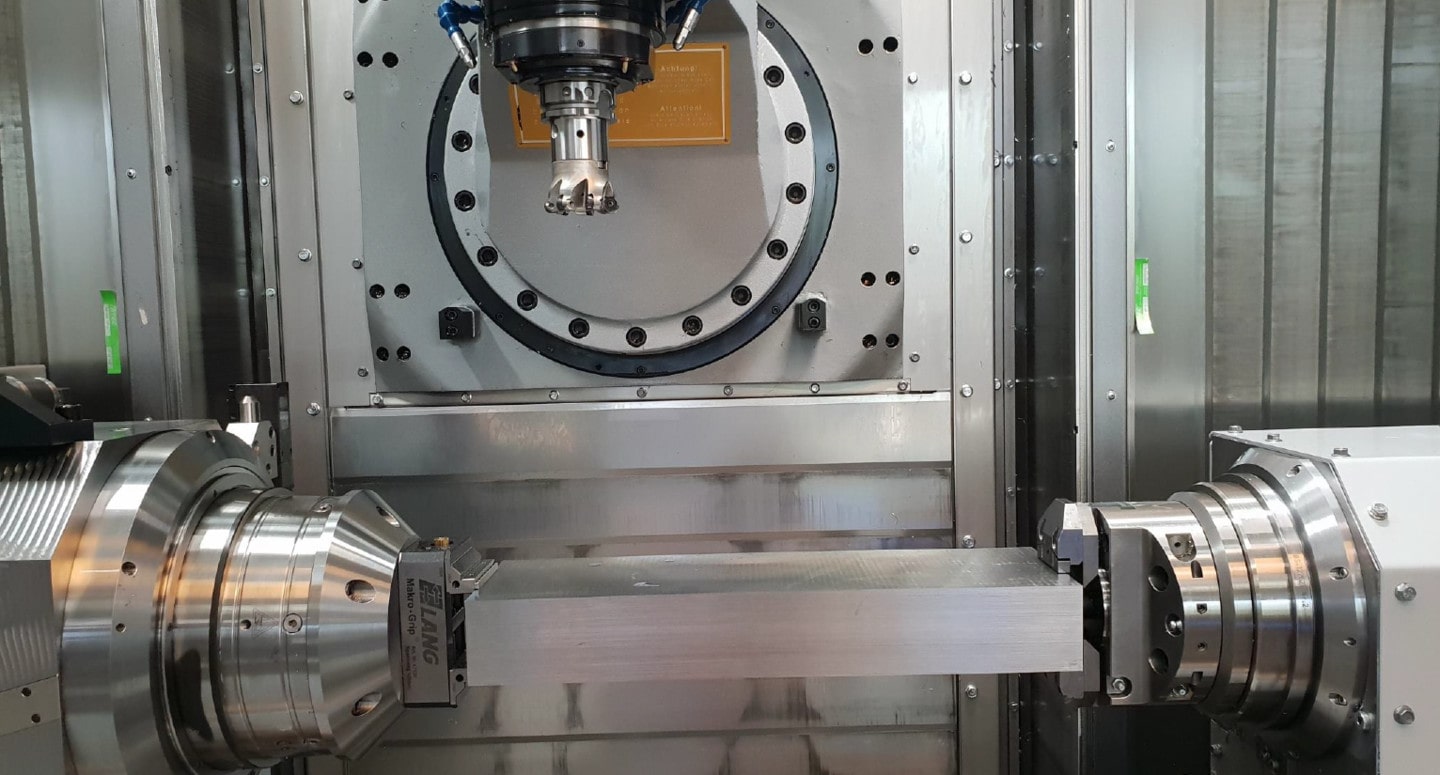
Research on the processing of turbine blades with minimum quantity lubrication Demo blades at Liechti Engineering on a Turbomill 1400i (turnaround time: 63min). The mass of the blank amount to: 150x70x480mm. Blaser Swisslube has carried out an extensive analysis of the milling of steel turbine blades in collaboration with GF Machining Solutions AG – Liechti Engineering and Walter AG. Conclusion: Minimum quantity lubrication (MQL) makes it possible to optimise the process and offers a savings potential when it comes to tool costs. The collaborative effort began about 1.5 years ago. Liechti Engineering initiated the project, intending to optimize the processing of turbine blades with the support of Blaser Swisslube and Walter. The blades, made of high-alloyed heat-resistant steel, are first roughened, and then pre- finished before a final finishing. The key processing phase in particular (meaning: the longest cycle time, and thus the highest production costs) was carefully examined throughout the course of the project. Blaser Swisslube’s Technology Centre During the initial tests at Blaser Swisslube’s in-house technology centre at the headquarters in Hasle-Rüegsau, X20 chrome steel blocks were milled using a GF Mikron HPM 800U – both rough-ing and finishing. The processing was carried out using a metalworking fluid, MQL, as well as dry and with pure compressed air cooling, and subsequently compared. Various cutting parameters were used. The MQL processing demonstrated its merits when it came to reduced flank wear during finishing, and the surface finish was very good as well. It therefore proved to be the ideal choice for this process. Technology Center and Competence Center of Blaser Swisslube in Hasle-Rüegsau Research results obtained by Liechti Engineering Further tests were then carried out at Liechti Engineering in Langnau. Blades were machined using a Turbomill 1400i. The results obtained match the findings made at Blaser’s technology centre. Apart from X20 chrome steel, Liechti Engineering also processed hard-to-machine X2 chrome steel in order to put the MQL process under scrutiny. Conclusion: Thanks to the MQL processing, the wear on the cutting edge is reduced and the tools have a longer life. This offers a savings potential with regards to the tool costs. Test showed that when finishing with MQL, tool wear can be reduced by a factor of up to 5 compared to metalworking fluid Result of the collaboration “MQL processing is the perfect choice for...
Steadily expanding our expertise in the field of minimum quantity lubrication The GROB G550 converted to MMS at the Blaser Swisslube Technology Center For this purpose, Blaser invested in a new GROB machine and converted it to minimum quantity lubrication (MQL). A holistic approach that takes into consideration all parameters involved in the process is typical. That is why Blaser also works with different partners, for example EMUGE. A metalworking fluid manufacturer interested in (or using) MQL—isn’t that a contradiction? For Blaser Swisslube, metalworking fluid and minimum quantity lubrication go hand in hand. What may sound a little strange to some, is normal for the Swiss family business. “We are committed to providing our customers with measurable added value in the field of cutting and grinding fluid and lubricant solutions. Whether it’s with a suitable cutting and grinding fluid or with a minimum quantity lubricant matched to the process,” explains Marc Blaser, CEO of Blaser Swisslube. In order to expand expertise in the field of MQL, a GROB G550 machine was purchased this year, which was specifically modified for MQL production. “We are looking to develop steadily, and better understand the fields of activity in MQL. To this end, we work closely with partners,” he concludes. Thread forming at the GROB with tools from EMUGE Competence in minimum quantity lubrication When using MQL, the entire process has to be taken into consideration. Significant progress has been made in the field of MQL over recent years, which also presents metalworking fluid manufacturers with the challenge of developing products specially suited for this purpose. Given the appropriate machining processes and the right implementation, Blaser Swisslube sees huge potential in MQL. Conversion to MQL requires adaptation of tools and process parameters. However, many users lack experience with MQL processes, which can be compensated for by the involvement of experts and the knowledge of tool, equipment and metalworking fluid suppliers. “With the machine converted to MQL, Blaser Swisslube can compare applications and materials with MQL, cutting and grinding oils and water-miscible coolants, and build up practical process knowledge. We want to provide answers to our customers’ questions – including in the field of MQL,” says Tobias Mathys, Process Engineering Manager at Blaser Swisslube. Process development with EMUGE A project with...
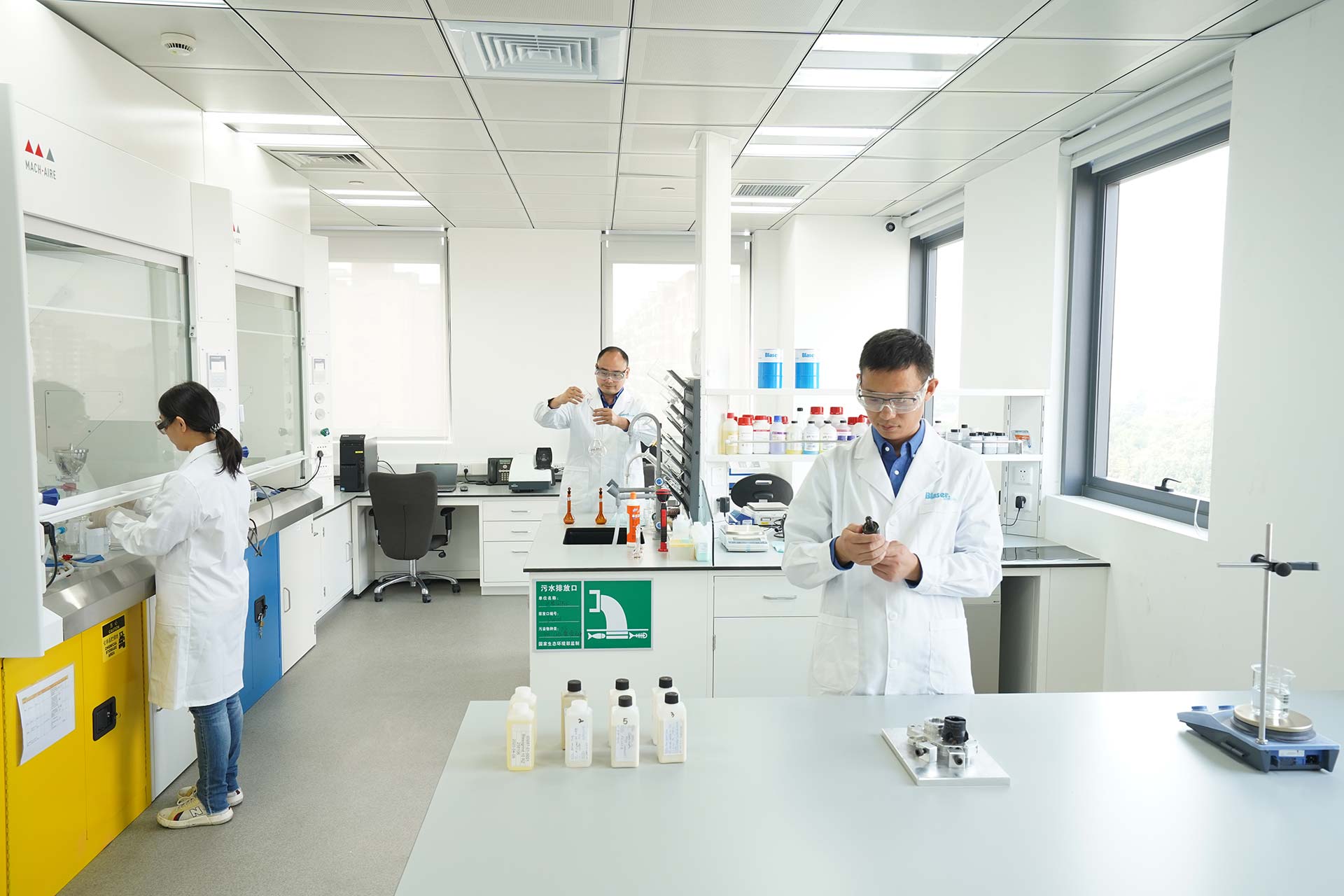
Blaser Swisslube opens laboratory in Shanghai, optimizing customer service The new laboratory allows the Blaser technicians to carry out targeted tests for the customers in the market and conduct product and chemistry related trainings for internal and external experts. The Swiss metalworking fluid expert Blaser Swisslube has opened a dedicated laboratory in its China subsidiary in Shanghai. A wide range of water and metalworking fluid tests can now be done locally, minimizing the test response time and underlining the customer service efforts of Blaser in this important and dynamic market. The Swiss company is known for its unique know-how and holistic approach that helps transform the metalworking fluid into a productivity boosting “Liquid Tool”. Titration Oil compatibility test Chip test Blaser Swisslube has opened its first domestic laboratory in the Chinese market. In the brand-new Shanghai laboratory, researchers and laboratory technicians conduct a wide range of tests. “The new laboratory helps us to cut the test response time in half, from two weeks to one week”, explains David Liu, Managing Director of Blaser Swisslube Central Asia. “China is a very important growth market for us. With the opening of the new laboratory we want to reinforce our efforts to provide unparalleled customer service in Greater China.” The new laboratory allows the Blaser technicians to carry out targeted tests for the customers in the market and conduct product and chemistry related trainings for internal and external experts. The laboratory examinations include a wide range of tests, from the concentration of water-miscible products, the pH value, hardness, average droplet size, chloride, conductivity, oil compatibility and foam tests all the way to metal corrosion tests. Mr. Liu: “All these tests can help to identify problems in the workshops and processes of our customers. Through our in-depth in-house expertise, we work together with our customers to find an ideal metalworking fluid solution and increase the productivity in the long run.” The Blaser customers in Greater China profit manifold: the test response time is faster, the Blaser input and problem solving is more accurate and quicker. Because the whole process is managed in China, there is no language barrier, minimizing potential misunderstandings. Liquid Tool “We strive to be more than just a provider of metalworking fluids”, emphasizes Marc Blaser, CEO of the...


Recent Comments